Our parents and grandparents were born in Cambodia, but they’ve always reminded us that we are culturally and ethnically Chinese. My great grandparents are from Swatow (aka Shantou), Guangdong, China. My great grandparents left China and emigrated to Cambodia. I never thought much about it. Although my parents tried hard to ingrain the Teochew language at home, we (the siblings and I) have become whitewashed. Instead of being fluent in our language, we speak mostly english at home. Most of our family speaks a mixture of english, Cambodian, and Teochew. Sometimes all three languages are used smoothly in one sentence, but at other times, the sentences are very choppy and full of pauses. We’ve grown quite used to hearing Enbochew (?) Cameoglish (?) and Teobodian (?) sentences.
While living in Toronto with my relatives in my first year at Humber, a lot of my Teochew came back. It was uncommon to hear English in their household. They spoke 90% Teochew. In fact, it was quite odd to hear them speak English, and I actually felt uncomfortable speaking English to them. My parents would’ve been thrilled had we, their four little trolls, spoke mostly Teochew when we grew up. English comes more naturally to us than Teochew. Using English just takes less effort.
That got me thinking. Since there are few Teochew food bloggers out there, why not start to incorporate more Teochew in ours. But before that, Lucy and I have thought about the way our family speaks Teochew and we’ve come to the conclusion that our ancestors were probably from the countryside in China. The way we pronounce particular words are probably butchered beyond recognition. And with that, let’s begin typing out these words phonetically -- or at least try, shall we? If you’re Teochew, it’ll probably take a couple of tries to understand it since it’s such a difficult language.
Referring to Wikipedia’s Chiuchow Cuisine page, here are two dishes:
Chinese characters: 咸菜鸭汤
English: Salted vegetable duck soup, or pickled mustard and duck soup
Teochew transliteration (according to wiki): Kiam cai ak terng
My take: Kiam chai ak tung
Kiam chai = salted vegetable
Ak = duck
Tung = soup
Kiam chai = salted vegetable
Ak = duck
Tung = soup
Chinese characters: 肉碎面
English: Minced pork noodles
Teochew transliteration (according to wiki): Bak chor mee
My take: Bak chau mee
Bak chau = minced pork
Mee = egg noodles (typically chow mein noodles)
Bak chau = minced pork
Mee = egg noodles (typically chow mein noodles)
Nu auy do kung bauy?
Are you hungry yet? (Asking someone who is younger than I am)
Ua ha a lao mai gai bak yong!
I love Grandma’s (on my dad’s side) pork floss!
Mai joi seuh. Ua mai giek gu chai guo.
No thanks. I don't want to eat garlic chive dumplings.
Mai joi seuh. Ua mai giek gu chai guo.
No thanks. I don't want to eat garlic chive dumplings.
Speaking of pork floss, we had muay (aka congee) for brunch a few months back. I love eating my grandma’s ba yong (pork floss) puauy (with) muay. And mee bao (toast). And bagels. And toasted sesame bagels spread with garlic butter. Ahem… unfortunately, we didn’t have any pork floss left but we did have a bunch of other things.
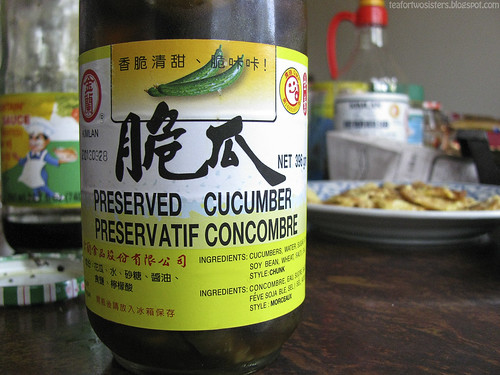

Huoi guoi (preserved cucumbers). This one is slightly sweet. There's a bottle of the see ew (Golden Mountain seasoning sauce; Maggi equivalent) to the left side of the jar of huoi guoi. We'll use the seasoning sauce to drizzle over pan-fried Chinese sausages.

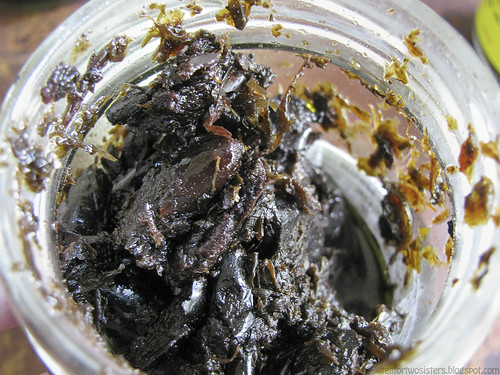
Ga na chai mixed with oh ga na (preserved olive leaves with Chinese olives).
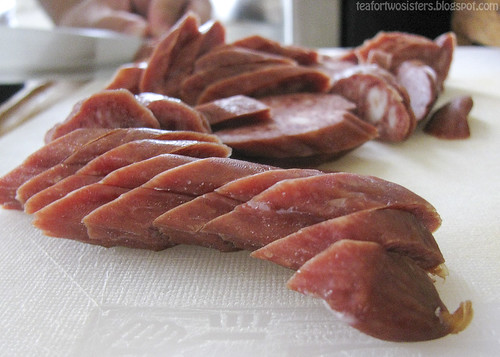
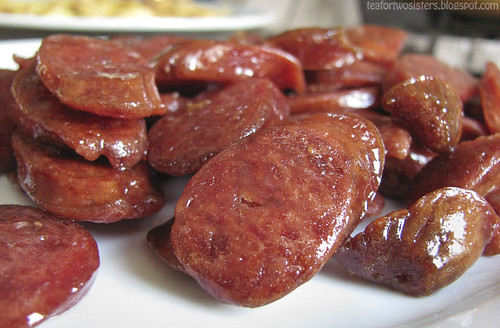
Gong chieng (Chinese sausages). The sausages were thrown back onto the griddle to get some colour after this photo was taken.
Richard made some chai poh nung (preserved daikon omelette). It’s really easy to make.

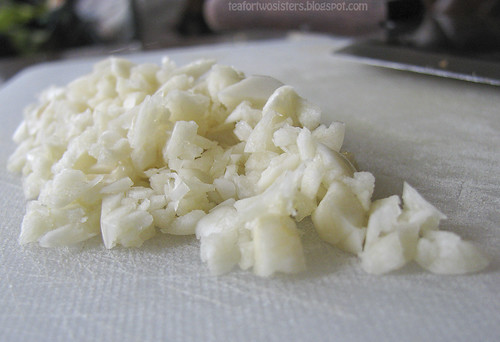
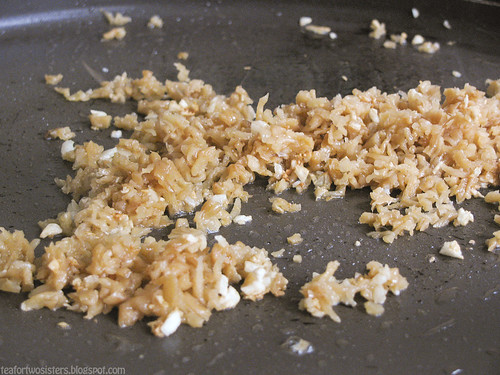
The chai poh is rinsed and then finely diced. If it isn't, I find the preserved radish has an artificial sweet taste much like aspartame. Unless you like that taste, make sure you give the radishes a good rinse. Sung tao (garlic) is minced and briefly gets sautéed until fragrant.
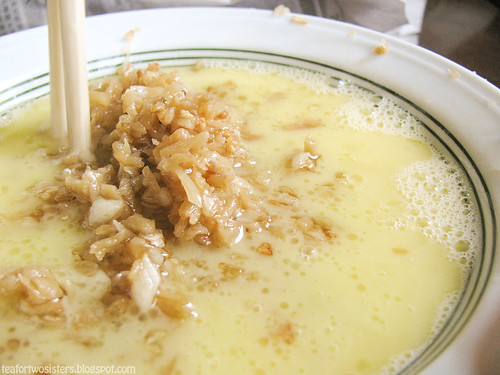


The mix is taken off the heat and added to a few scrambled eggs. The whole mix was poured out onto the hot griddle, cooked, then flipped/folded. The chai poh nung was a bit overdone as you can see by the colour of the eggs.

We had some leftover gong dao guo (braised dry tofu). Pork and cabbage was braised along with the tofu.
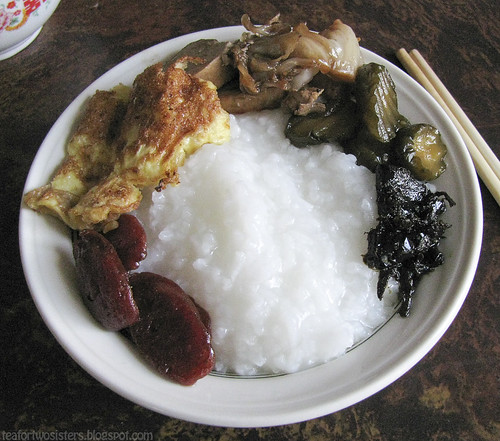
When we make muay, it’s usually looser and more liquid than what’s pictured here. This batch was quite thick.
Other than bak yong, we usually eat congee with who you (preserved tofu and soy beans). Congee is very comforting, especially when you have lots of things to eat it with. Our family typically eats congee when someone is sick, but it's also quite nice to have it for brunch once in a while.
So yeah. We are Teochew. Don't be shy to comment if you are too. Where are all the Teochew nang (people) at?


can you tell me what brand you used for the preserved daikon radish, I've been trying to look for that.
ReplyDeleteHi lilktmus, I can't recall what brand we use. We've been trying a bunch of brands that we are found at our local Chinese grocery stores. I'm so helpful, I know.
DeleteHello from Australia. It's great to find a site with Teochew emphasis. I cook a lot of foods from the various regions of Asian countries but it is hard to get good regional cookbooks translated into English although there are some emerging in recent years.
ReplyDeleteToday I'm making Teochew Braised Duck and came to the web hunting for a soup to serve. Luckily I found this site.
Lilit
Hello Ladies! Just found your blog by recommendation from a fellow Diojiu nang's posting on the Facebook group Gaginang. I'm a fellow Diojiu also. My blog is at BestFriendBeautyTips.blogspot.com. Love your post on mue! Still trying to get my husband to eat it. His gua mah made him eat it eaveryday as a child and he is traumatized. I showed him this post and told him to look how yummy it can be!
ReplyDeleteYay! It's always nice to find more Gaginang in the world.
ReplyDeleteHey, this is cool! I'm also a Torontonian brought up from a family of a mostly ethnically Chinese background but they emigrated from Cambodia. It's nice to be able to find people who also speak Teo Chew. Thanks for posting! :D
ReplyDeleteSo excited to have found more Teochew nangs here. Anymore Torontonians around? Why don't we get together for a cooking session or some sort :)
ReplyDeleteBtw Christine, I used to go to Humber too :)
Woah, time out! You went to Humber AND you're also Teochew? That's awesome. Unfortunately I'm currently back in Ottawa, but I like the idea of getting together. Keep me posted if the idea picks up.
DeleteSO cool gals, I never expect to find a fellow teochew online in Toronto! Miss those Teochew Muay times back home in Singapore. Would try and read your blog more , good job.
ReplyDeleteHi Conney, we're actually in Ottawa but there are still lots of Teochew nang in Toronto. We'll try to add more Teochew posts in the future.
Delete